A hydraulic cylinder rarely fails without warning. Slow drift under load, a scored rod, a weeping seal – reason enough to open it up instead of guessing at the cause. Disassembly on its own fixes nothing. It's the inspection that decides whether repair is worth doing, or a new cylinder is the better answer.
Safety first: pressure and stored energy
Before any cylinder is opened, the circuit has to be fully de-energised. That means isolating the pump, cycling the directional valve in both directions to bleed residual pressure from both chambers, and blocking the load so the piston cannot travel under its own weight or a suspended mass. A cylinder that still has a load resting on the rod, or oil trapped between a closed valve and the piston, stores enough energy to eject a gland or a locking ring with real force. The cylinder should also be clamped or supported on a bench or in a vice rated for its weight – long-stroke and large-bore units are awkward and heavy enough to cause injury on their own, independent of hydraulic energy.
Only once the unit is at atmospheric pressure and mechanically secured does it make sense to start on the gland nut, tie rods or retaining ring, depending on the cylinder's design.
What the inspection is actually looking for
Once the cylinder is open, each component tells its own part of the story. The rod is usually the fastest read on what went wrong, but it rarely tells the whole one:
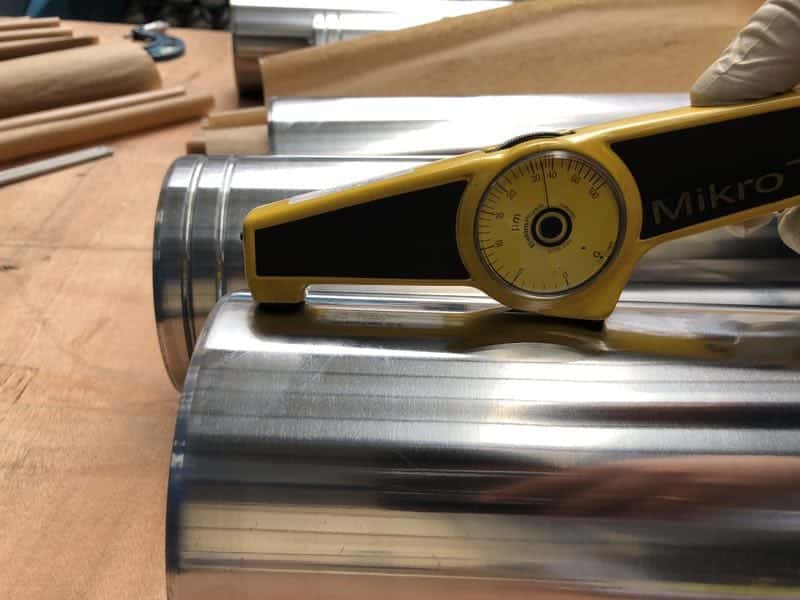
- Rod – longitudinal scoring or pitting on the working surface, flaking or peeling of the hard-chrome layer, local corrosion under a damaged coating, and bending checked against a straightedge or on rollers. A bent rod is a common reason a cylinder starts leaking at the gland even though the seals themselves are still serviceable.
- Barrel (bore) – scoring, out-of-round wear concentrated at the stroke ends, and corrosion pitting, usually measured with a bore gauge at several points along the length.
- Piston – wear in the seal grooves, wear or scoring of any piston bearing rings, and looseness on the rod thread or lock.
- Seals and wear rings – hardening, extrusion into the clearance gap, spiral failure on rod seals, and any sign that a hard particle has cut through a lip. Seal condition alone rarely explains a leak. Check whether wear on the metal parts caused the seal damage, not the other way round.
Photographs and measurements taken at this stage are also what a workshop needs later to decide on tolerances and to order the correct replacement seals.
When repair makes sense, and when it does not
A cylinder is a good repair candidate when the damage is confined to parts that can be reground, re-chromed or replaced without touching the barrel's structural wall thickness: a scored rod that can be reground and re-plated within its diameter tolerance, a bore that can be honed within the original fit, or seals and wear rings alone. In these cases repair restores the original working clearances at a fraction of the cost of a new cylinder.
Repair stops making sense once the barrel bore is worn or corroded beyond a safe honing allowance, once the rod diameter falls below the minimum for re-chroming and grinding, or once cracks, thread damage or bent mounting lugs are involved. Fixing all of that on an old body frequently costs close to a newly manufactured cylinder, without the same certainty on service life. Past that point, it's usually cheaper to build a new cylinder to the same working parameters, or a same-design replacement based on the original as a sample, than to keep restoring a worn one.
What to send us for a replacement or matching cylinder
If disassembly shows that a new hydraulic cylinder or replacement rod/barrel set is the right call, the fastest path to an accurate quote is to send what the teardown already produced: the bore and rod diameters, stroke length, working pressure and mounting type (trunnion, clevis, flange), plus a drawing if one exists. Where no drawing survives, the disassembled rod, barrel or piston itself works as a reference sample, together with clear photos and the measurements taken during inspection.
What is useful to include in your request
- Bore diameter, rod diameter and stroke, measured during disassembly
- Working pressure and the application (mobile machinery, press, lifting equipment)
- Mounting type and any known seal brand or profile
- A drawing, sketch or physical sample of the worn parts
Send these details through our contact page and we will confirm which parts need remanufacturing and which can be supplied as a complete replacement cylinder.